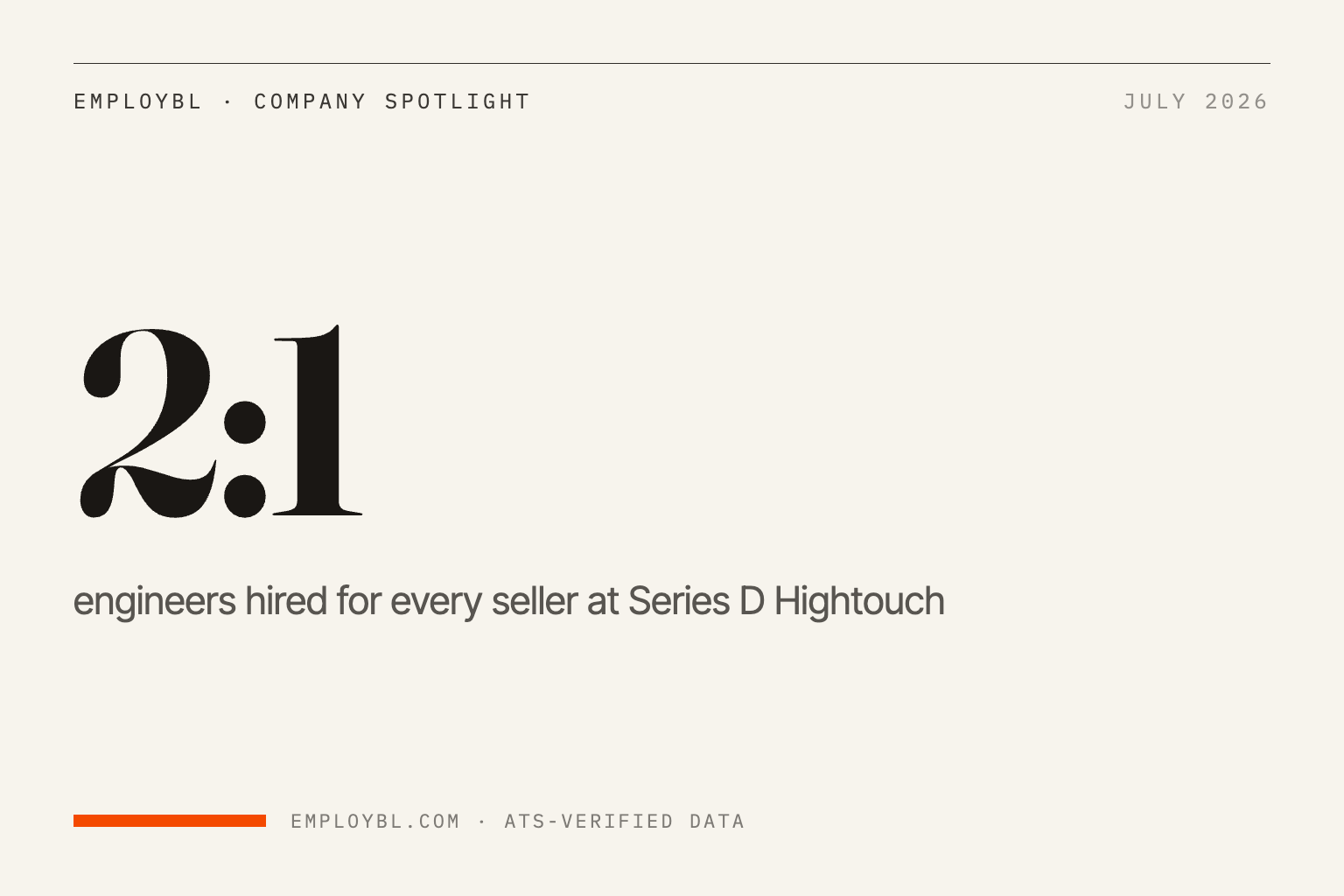
Hightouch is hiring two engineers for every seller. Of its 64 open roles, 38 are engineering and 19 are sales — and at Series D, that ratio is the story. I run Employbl, where we track 90,150 active ATS-verified listings, and the late-stage pattern I'm used to seeing is the opposite: by the time a SaaS company raises its D, the product is largely built and the hiring tilts hard toward go-to-market. Hightouch's $150M Series D, closed April 29, 2026, is funding product.
The 2:1 ratio, unpacked
Here's the full mix across the 64 active listings, bucketed by job title:
- Engineering/Technical: 38 roles — 59% of all openings
- Sales and go-to-market: 19 roles
- Product: 1 role
- Operations and support: 1 role
- Other (legal, finance, people): 5 roles
Two numbers stand out. The first is the 38, which puts engineering at 59% of current openings — a share I'd normally see at Series A or B, when the product race is still on. The second is the 1: a single product opening. Nineteen sellers isn't a small GTM build — it's nearly a third of all openings — but the company is pairing every one of them with two engineers.
The single ops-and-support opening reinforces it: this isn't a company staffing a big support org or a scaled operations function yet. The hiring plan is engineers to build and sellers to sell what's built, with almost nothing in between.
So why does the ratio look like this? One reading — the one I lean toward — is that the composable-CDP category still competes on product depth. Hightouch sits on top of the customer's own data warehouse, which means the roadmap fight — reverse ETL, identity resolution, AI-driven audience building — is far from settled. When a category is settled, Series D money buys market share. When it isn't, it buys engineers.
There's a second signal in the stack itself. The top technologies our extraction pulls from Hightouch's listings — SQL, Snowflake, Databricks, BigQuery — are warehouse primitives, not go-to-market tools. Compare Sierra, whose listings surface Salesforce, Google Workspace, and Tableau: the toolkit of a company deploying into other people's enterprises. Hightouch's toolkit says its engineers are being hired to move, resolve, and activate records inside the customer's own warehouse. When the product is infrastructure, the engineering bar is the moat — which is exactly what a 2:1 engineer-to-seller ratio at Series D looks like from the inside.
See full profiles for these companies
A free account gets AI research, tech stacks, hiring focus, and 75K+ ATS-verified job listings — no credit card, and email alerts are free. MCP and REST access are free and uncapped too.
Sign up free →Two other readings deserve space. Warehouse-native go-to-market may simply be efficient: Hightouch sells to companies that already run Snowflake or Databricks, which means a defined, reachable account list — and possibly fewer sellers per dollar of revenue than a classic top-of-funnel SaaS motion. And open roles are a snapshot of growth direction, not an org chart: it's possible the sales team is already largely built, and what we're seeing is this year's increments rather than the company's shape. All three readings probably contribute. The part that stays interesting either way is that the company's own hiring page leans this clearly toward build.
For calibration against the other companies we've profiled this summer: Waymo runs 273 engineering roles against 4 sales (it sells rides, not software), and Sierra runs 63 against 30. Hightouch's 2:1 is the pure-SaaS version of the same signal — a company that believes its moat is still being dug.
The funding staircase: grind, then pop
Hightouch's funding history is the grind-then-pop pattern in miniature: a $2.1M seed in December 2020, a $12.1M Series A in July 2021, a $40M Series B in November 2021 — then the long quiet stretch. A $38M Series B extension arrived in July 2023, deep in the downturn, followed by an $80M Series C in February 2025 and a $10M C extension in July 2025. Finally, the $150M Series D on April 29, 2026. That's $332M+ raised across seven events over five and a half years.
The two extensions are the tell. Companies raise extensions when they need runway but can't — or don't want to — reprice. Hightouch took bridge capital through the 2023 trough, kept building, and came out the other side with a single round of $150M — not far off the $182M it had raised across the previous six events combined. The staircase says the same thing the org chart does: this is a company that survived on product and is still betting on it.
What this means if you're job hunting
The stack tells you who they need. From our extraction over Hightouch's own listings: SQL, Snowflake, Databricks, Salesforce, JavaScript, Python, TypeScript, BigQuery, and Node.js. This is warehouse-native territory — if you've built on Snowflake or Databricks, you're speaking the product's native language, and 38 open engineering roles at a company with 64 total openings is a deep market.
For sellers, the 19 GTM openings are a real build-out — nearly a third of all hiring — and selling a warehouse-native product means your buyers are data teams as much as marketers. For product managers, the signal is honest and harsh: one opening. That door is essentially closed this cycle.
The 2:1 ratio is also worth reading as a category signal before you apply anywhere in this space: a Series D company still spending majority-engineering is betting the prize is ahead of it, not behind it. That's exactly the kind of bet you want to vet before you commit an evening to the application — which is the whole point of reading the org chart, not just the job post.
Methodology
Dataset: 90,150 active ATS-verified job listings pulled directly from company career boards on Greenhouse, Lever, and Ashby, as of July 16, 2026 — a broad but partial picture, covering companies that hire through those three ATS providers. Role-mix buckets are title-based classification and imperfect — ambiguous titles land in Other. Open roles indicate growth direction, not total headcount. Funding data comes from our funding-rounds index; some rounds appear twice in raw source data, so the figures above use de-duplicated distinct amounts. Tech-stack signals are extracted from the text of Hightouch's own listings.
Hightouch's full profile — funding history, tech stack, and all 64 live roles — is on Employbl. For the wider field, browse SaaS companies hiring now or companies based in San Francisco.
