I run Employbl, a job-search intelligence site that syncs 90,376 live job listings straight from the applicant tracking systems — Greenhouse, Lever, and Ashby — of 2,945 tech companies. Last week I tried to answer a simple question: what fraction of startup job posts actually tell you the salary?
I got three different answers: 1%, 31%, and 67%. All three are in this post, because the gap between them turned out to be more interesting than the question.
Pass 1: the database says 1.2%
My first query counted listings where our pipeline had extracted a minimum or maximum salary. Result: 213 of 18,166 active California listings — 1.2%. In Colorado, which has had a pay-transparency law since 2021, it was 0.9%. That would have been a scandalous headline. It was also completely wrong.
The 1.2% measured my own extraction pipeline's recall, not employer behavior. If you've ever seen a jaw-dropping statistic computed from someone's scraped dataset, this is your reminder to ask how the field got populated.
Pass 2: the description text says 31%
Second attempt: regex the full job-description text for salary ranges ($140,000 – $180,000, $150K–$180K, hourly ranges). Now California showed 31%, New York 43%, Texas 10%. A clean story — transparency laws triple disclosure! — and still wrong.
I spot-checked the "non-disclosing" listings and immediately hit a Robinhood posting with no salary anywhere in its description text — while the live Greenhouse page showed $196,000–$230,000 in a structured pay-range block. Greenhouse added first-class pay-range fields for compliance, and they render outside the job description. Any scraper that only reads the description body — which is most scrapers, including mine — silently misses them.
Pass 3: the live pages say 67%
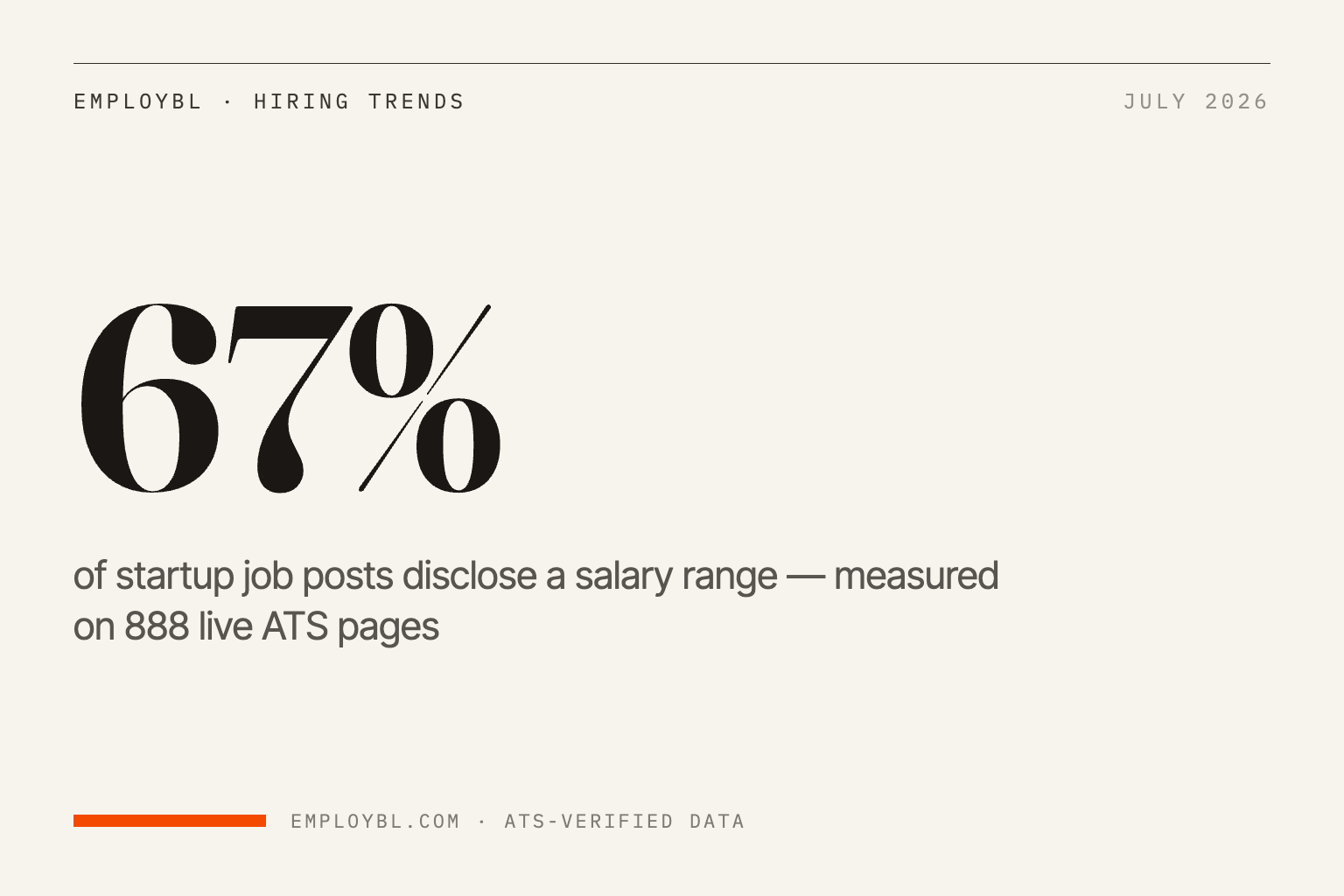
So I measured it the hard way: a stratified random sample of ~1,000 active listings — 100 per state, one per company, across five states with pay-transparency laws (CA, NY, CO, WA, IL) and five without (TX, FL, GA, NC, PA) — fetching every live ATS page and checking the rendered HTML for a salary range or a structured pay block. 888 pages were reachable. 592 disclosed pay: 67%.
By state (share of live postings disclosing a pay range, July 2026):
- California (law since 2023): 76.7%
- Washington (law): 76.4%
- New York (law): 70.2%
- Georgia (no law): 68.5%
See full profiles for these companies
A free account gets AI research, tech stacks, hiring focus, and 75K+ ATS-verified job listings — no credit card, and email alerts are free. MCP and REST access are free and uncapped too.
Sign up free →- Florida (no law): 67.8% · North Carolina (no law): 67.8%
- Pennsylvania (no law): 65.2%
- Colorado (oldest pay-transparency law in the country, 2021): 62.8%
- Illinois (law since 2025): 62.5%
- Texas (no law): 50.0%
The laws barely mattered
Aggregate the sample and states with pay-transparency laws disclose at 69.6% versus 63.8% without — about six points. Georgia startups, under no legal obligation whatsoever, post salaries more often than Colorado startups five years into the country's first transparency law. If you'd told me that before I ran the numbers, I wouldn't have believed you.
My read: pay transparency won as an industry norm, not as a compliance exercise. Candidates started expecting ranges, the big ATS vendors made them a first-class field, and the default flipped. The laws were the starting gun, not the race.
The real transparency layer is the ATS
Disclosure rates split cleanly by which ATS the company uses: Greenhouse boards disclosed on 70% of sampled postings, Lever 55%, Ashby 52%. Greenhouse built a dedicated, validated pay-range widget and companies filled it in. The product decision of an ATS vendor moved disclosure more than most state legislatures did.
What this means if you're job hunting
Two-thirds of startup listings will tell you the range before you apply — so treat the third that won't as a signal. A company that hides comp in 2026 is choosing to, against the industry default. And if a listing looks silent on pay, check the live posting: the range often sits in the ATS pay block that aggregators and job boards strip out.
Methodology
Dataset: 90,376 active job listings synced directly from the public Greenhouse, Lever, and Ashby boards of 2,945 venture-scale tech companies, as of July 15, 2026. This skews toward funded startups — it is not a census of all US employers. Pass 1 counted listings with salary fields populated by our extraction pipeline. Pass 2 ran salary-range regexes over stored description text ($-ranges, K-ranges, hourly ranges). Pass 3 sampled up to 100 active listings per state (one per company, random), fetched each live ATS page, and matched the rendered HTML for either a salary-range pattern or an ATS structured pay block; the structured-block matcher was validated by hand (e.g. Checkr's pay-range div contains $202,000–$261,800). 888 of ~1,000 sampled pages were reachable; unreachable pages were excluded rather than counted as non-disclosing. Per-state samples of ~90 give roughly ±5 percentage-point margins — treat single-state gaps under that as noise. Remote-eligible listings are attributed to their posted location, which understates the reach of CA/NY/CO laws that can cover remote roles. All aggregate numbers in this post are reproducible from the queries and sampling script described here.
Employbl tracks live listings, funding, tech stacks, and team data for 25,000+ tech companies. If you want to see which of the companies you're interviewing with disclose pay — or anything else about them — you can look any of them up.