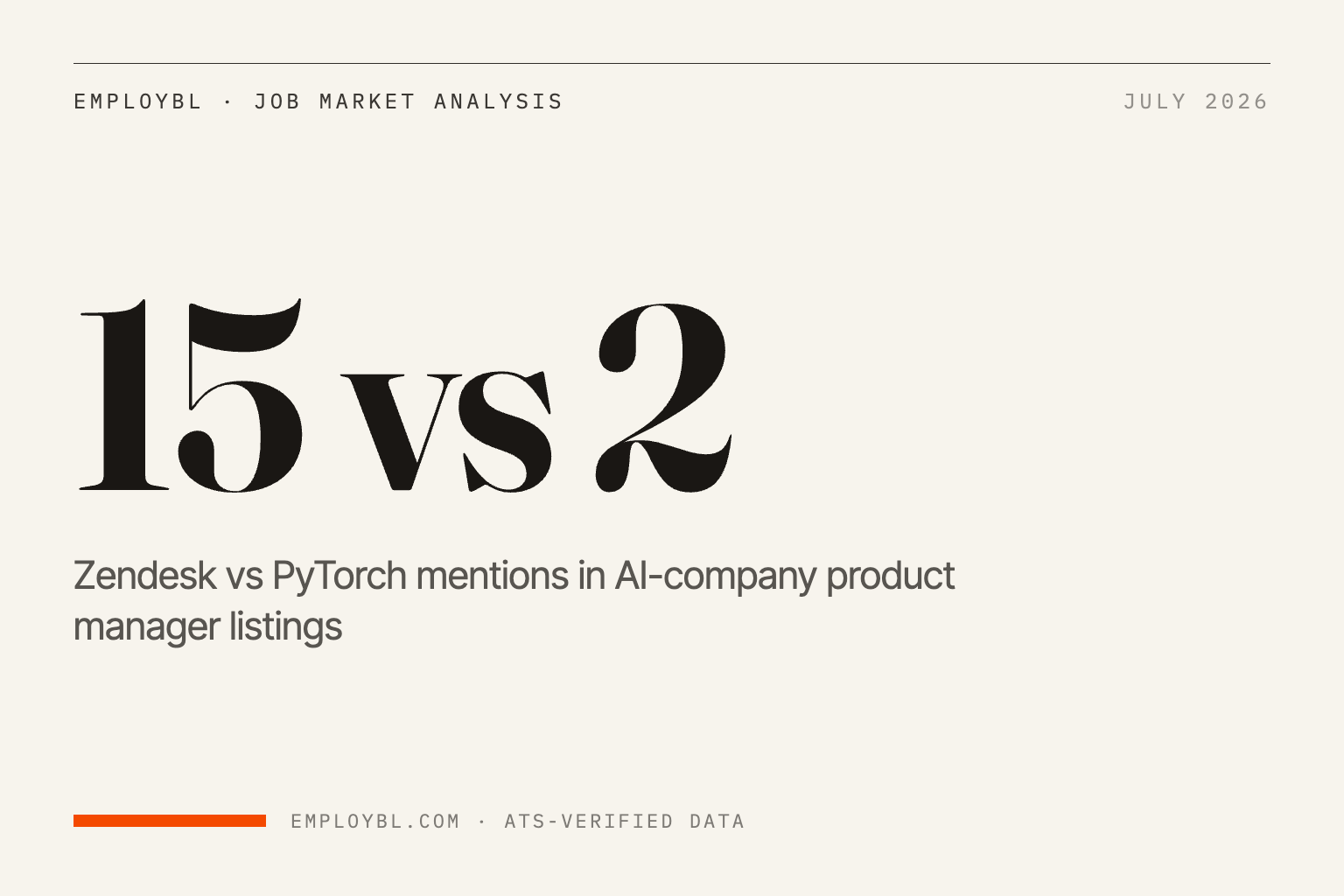
Judged by what the listings actually name, the product manager job at AI companies is not a research job. Across the 138 active PM listings at AI & ML companies in our tracker, Zendesk gets 15 mentions, ServiceNow gets 15, GitHub gets 15 — and PyTorch appears in 2. I run Employbl, and when we ran our skill extraction over every active PM listing at AI and SaaS companies, the two cohorts split into two different jobs wearing the same title: the AI-company PM deploys agents into enterprise support stacks; the SaaS PM lives in the data stack, where SQL is the single most-named skill.
Scope note: both cohorts come from the Greenhouse/Lever/Ashby universe — venture-backed startups and scaleups. Big Tech's PM organizations hire through internal boards we don't track, and AI labs fill many roles through networks that never touch a job board. Read these tables as the startup market's stated requirements, not all of tech's — and as open recs, not hires made.
What AI-company PM listings actually name
Top skill and tool mentions across the 138 active AI-company PM listings (dictionary extraction over listing descriptions, confidence ≥0.5):
- GitHub — 15 mentions
- ServiceNow — 15
- Zendesk — 15
- Salesforce — 6
- AWS — 6
- Python — 5
- PyTorch — 2
That tool list is an enterprise-support integration map, not an ML curriculum. ServiceNow and Zendesk are where enterprise support tickets live; GitHub is where the agents' work lands. The 2026 AI-company PM is the person who gets an agent product deployed into a customer's existing support stack and proves it resolves tickets — model fluency is assumed or irrelevant, integration fluency is the job. The hiring side agrees: among companies tagged Artificial Intelligence on Employbl, the deepest PM pipelines include Sierra (17 open PM listings), Decagon (10), and Cresta (8) — all three build AI agents for customer support.
The SaaS PM is a data job now
The SaaS cohort — 480 active PM listings at 191 companies across developer tools and sales & marketing software — names a completely different toolkit:
- SQL — 51 mentions
- AWS — 43
- Databricks — 38
See full profiles for these companies
A free account gets AI research, tech stacks, hiring focus, and 75K+ ATS-verified job listings — no credit card, and email alerts are free. MCP and REST access are free and uncapped too.
Sign up free →- Azure — 34
- Salesforce — 33
- Google Cloud — 31
- Kubernetes — 29
- Datadog — 29
SQL beats every cloud, every CRM, and every observability tool. The mature-SaaS PM job has quietly converged on data-stack fluency: pull your own numbers, know where the warehouse lives (Databricks, 38 mentions), read the dashboards (Datadog, 29). Where the AI-company listings ask "can you get our product into the customer's stack," the SaaS listings ask "can you self-serve the evidence for your roadmap." You can see which tools any given company runs on our tech stacks pages — worth checking before you claim fluency in an interview.
Salesforce is the one tool with real presence on both lists — 6 mentions on the AI side, 33 on the SaaS side — and it marks the common ground: both jobs ultimately answer to an enterprise go-to-market motion. The difference is the direction of travel. The SaaS PM reads Salesforce to understand their own pipeline; the AI-company PM treats it as one more system their agent has to live inside.
Why support is the beachhead
My best guess: customer support is the first agent market with ROI a buyer can measure inside a quarter. Deflection rate is a number that goes in a board deck — "the agent resolved this share of tickets" — which is why the first generation of enterprise agent companies sold into support, and why their PMs live in ServiceNow and Zendesk. The PM skill list is downstream of where the revenue is.
One reading of where this goes: it doesn't stay this way. As agents spread beyond support into other enterprise workflows, expect the AI-PM skill list to drift toward whatever systems those workflows live in — this table is a snapshot of the first beachhead, not a permanent definition of the job. If you're betting a career on AI product management, the durable skill is the deployment motion itself, not any one ticketing system.
Same title, two interview loops
This split is not academic — it changes what you should prepare. For an AI-company PM loop, the strong candidate walks in with a point of view on enterprise deployment: how an agent gets wired into a ServiceNow or Zendesk workflow, what the rollout and escalation path looks like, how you measure resolution quality against a human baseline. It is the PM version of the same gravity pulling engineering — AI companies are staffing Forward Deployed Engineers at a rate no other sector matches, and the PM sits on top of that deployment motion. For a SaaS PM loop, expect the SQL exercise and the metrics case; the listing told you so, 51 times over.
Two market notes before you aim. Volume: SaaS PM openings outnumber AI-company ones 480 to 138 — 3.5 to 1 — so the AI-PM path is the narrower door, whatever the narrative suggests. And transparency: only 3 of the 138 AI-company PM listings and 6 of the 480 SaaS ones post a salary range, which is why we're not publishing salary medians for either cohort — the samples are too small to be honest about. Both sides of this market make you interview to learn the number.
Which companies should you research first?
If the AI-PM job is deployment, favor companies whose customers you can name and whose support-stack integrations are public — the Sierra/Decagon/Cresta cluster is the cleanest expression of the pattern. If the SaaS-PM job is data fluency, favor companies whose stack you already speak. Either way, research the company — funding, team, the rest of their hiring slate — before you spend an evening tailoring a portfolio to a listing that told you exactly which job it is, if you read the tools it names.
Methodology
Dataset: 90,150 active, ATS-verified listings pulled from Greenhouse, Lever, and Ashby as of July 16, 2026, across the 25,000+ companies Employbl tracks. PM cohorts: 138 active product-manager listings at 43 companies whose primary sector is AI & ML, vs 480 at 191 SaaS companies (developer tools & infrastructure plus sales & marketing software sectors). Skill and tool mentions come from our job_skills dictionary extraction over listing descriptions at confidence ≥0.5 — a dictionary matcher counts tools the listing names, so it measures stated requirements, not everything the job involves. Per-company PM counts (Sierra, Decagon, Cresta) come from a same-day tag-based query and may classify companies slightly differently than the sector cohorts. Salary figures are withheld: only 3 AI-company and 6 SaaS listings post ranges. Both cohorts are drawn from companies hiring through these ATS platforms — Big Tech PM organizations and network-hired roles sit outside the index, and listings measure stated demand, not hires made.


