Last week 37 of our 99 new signups arrived from ChatGPT, and every one of those 37 landed on a single job page — not the homepage, not a search result. That is a different motion from browsing a job board: people ask an assistant, and click the one thing it hands back. Over the same stretch our AI-assistant referral sessions roughly doubled while search and direct traffic fell.
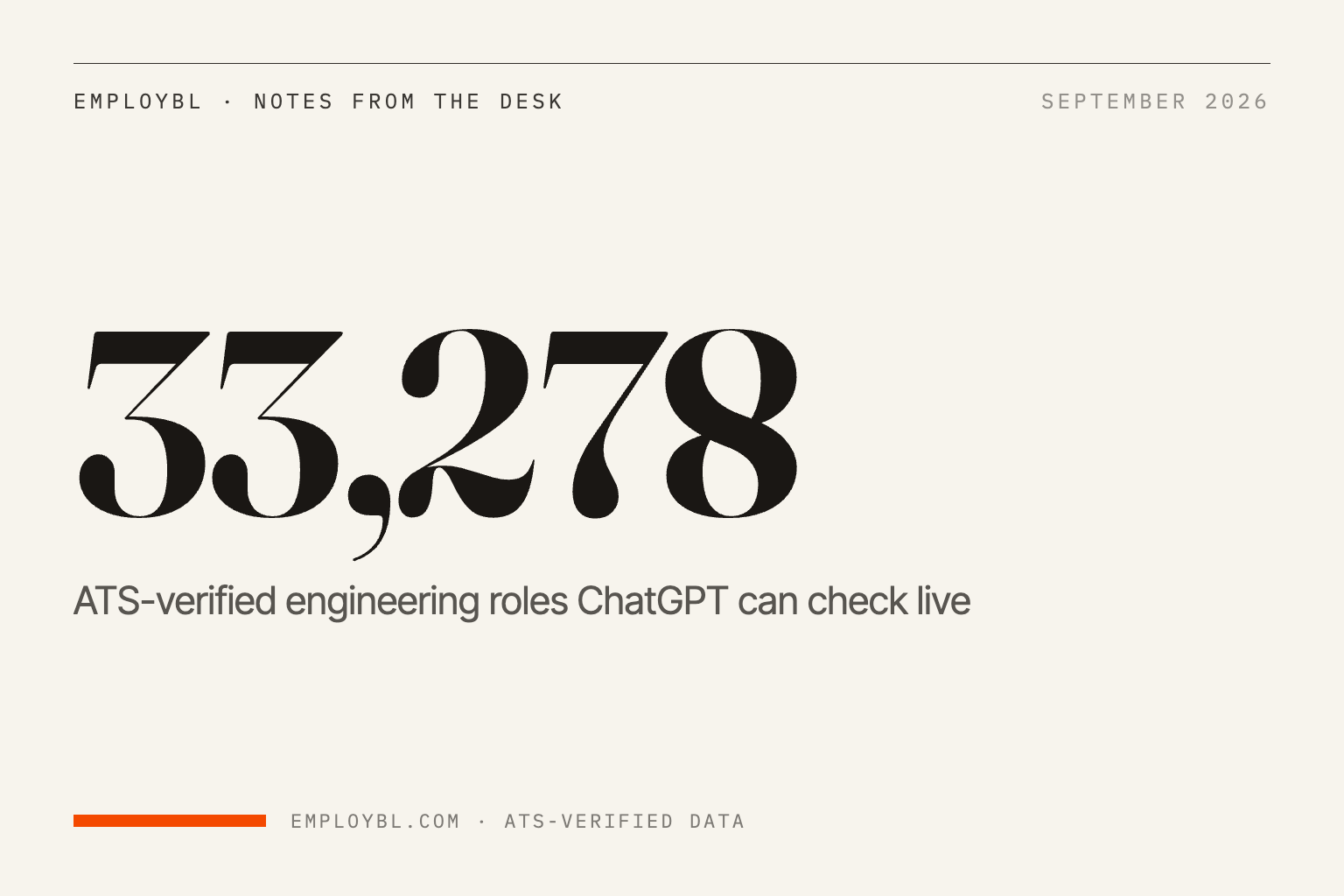
I run Employbl, a live dataset of tech companies. This is what ChatGPT can and cannot tell you about engineering jobs, the prompts that produce something useful, and how to point it at 33,278 ATS-verified engineering roles instead of its own memory.
Why ChatGPT invents job listings
A model answers from a training snapshot. Job listings are among the fastest-decaying facts on the internet — a posting is opened, filled and taken down inside a quarter, and nothing about that churn reaches the model. So when you ask for open backend roles at Series B companies, a model with no live source produces something that reads exactly like an answer: plausible company names, plausible titles, roles that closed months ago or never existed.
For comparison, here is what the live picture looks like in our index right now, pulled from the companies' own applicant tracking systems rather than from a scrape or a submission form:
- 109,888 active roles across 30,980 companies.
- 33,278 of them engineering, at 3,657 companies.
- 2,904 cities in 140 countries — the index is not US-only, though it is US-heavy.
None of that is knowable from training data. It is knowable from a query, which is the whole difference between the two ways of using an assistant below.
Can ChatGPT search for live job listings?
Partly, and the distinction matters. With browsing switched on, ChatGPT can read a page you point it at — a specific job posting, a specific company profile — and summarise it accurately. What it cannot do on its own is enumerate a market: rank every funded robotics company hiring embedded engineers, or filter 33,278 roles by seniority and location. Reading one page and querying a dataset are different operations, and asking for the second while it can only do the first is where the confident, wrong answers come from.
So the practical split is: give it a page to read, or give it a database to query.
Prompts that produce something you can act on
The pattern that works is to stop asking for listings and start asking for judgement about companies, then go to the live source for the roles themselves.
- Point it at a page, not a market: paste a company profile URL and ask "what has this company raised, who from, and what does their stack look like?" It will read and summarise rather than guess.
- Ask for a shortlist to verify, not a final answer: "list 10 funded companies working on satellite hardware" is a research prompt. Treat the output as candidates to check, not as fact.
- Ask the vetting questions a listing does not answer: runway, who led the last round, whether the team has shipped before, whether the stack matches what you want to work in.
- Ask it to compare rather than to rank: two named companies side by side produces far more reliable output than "best companies for engineers", which is a request for an opinion it will invent.
Then take the shortlist somewhere that can answer the market question — the jobs index filters the live roles, and each company profile carries the funding, stack and team behind them.
Three things a job listing never tells you
See full profiles for these companies
A free account gets AI research, tech stacks, hiring focus, and 75K+ ATS-verified job listings — no credit card, and email alerts are free. Premium ($25/mo) adds unlimited API calls.
Sign up free →A listing is a description of a role. The decision you are actually making is about a company, and three kinds of context change that decision more than the job description does.
Funding, because it sets the clock.
We track 75,534 rounds across 24,138 companies, and 14,582 of those 33,278 engineering roles — 44% — are at a company that raised in the last twelve months. Hermeus raised a $200M Series C in April and has 59 engineering roles open. Astranis raised a $300M Series E in May and has 56. That is a materially different bet from a company whose last round was four years ago, and the listing looks identical either way.
Location, because "remote" and "hybrid" hide more than they say.
29,322 companies are plotted on the map, so "who is hiring within a commute of me" is a question you can answer by looking rather than by reading 200 listings that all say hybrid. It is also the fastest way to find the companies you had never heard of, which are most of them.
Pay, because most listings still will not say.
13,588 of the 109,888 active roles carry a real salary range — about 12%. The other 88% are a conversation you have after investing several evenings. Knowing which is which before you apply is worth more than another ten listings.
Or skip the copy-paste entirely
If you use Claude, Cursor or another MCP-capable client, you can connect the dataset directly rather than pasting URLs into a chat window. Our MCP server exposes 27 tools over the same live data — search jobs, compare companies, pull recent funding rounds, find companies near a location — so the assistant queries the database mid-conversation instead of answering from memory. The free allowance is 100 metered calls on any verified account.
If MCP is new to you, we wrote up what it is in plain words and how to connect a client in about five minutes.
Why the assistant became the front door
The share of our signups arriving this way went from a rounding error to the largest attributed channel in a quarter, while Google and direct both fell. I do not think anyone should state confidently why. Three readings, offered as hypotheses:
- One reading: the query itself changed. "Find me software engineer jobs at funded startups in Austin" is a sentence, not a set of filters, and a chat box accepts sentences where a job board demands a schema.
- Another reading: it is substitution, not new demand. The same people who would have searched Google now ask an assistant, and the traffic simply moved. Our own numbers are consistent with this — search fell as AI referrals rose.
- A third, and my best guess: assistants reward structured, current, machine-readable sources, and most job content is none of those. That is a temporary advantage for anyone who maintains a real dataset, and it will compress as everyone else notices.
Worth saying plainly: this is one site's data over one quarter, and the growth rate is set by someone else's model. I would not build a plan on it lasting.
Methodology and scope
Counts are live reads from the Employbl database on 2026-09-06: 30,980 companies, 109,888 active job listings, 75,534 funding rounds, 29,322 companies with mapped coordinates. Roles are pulled from companies' own applicant tracking systems — Greenhouse, Lever, Ashby, Workable, BambooHR, Rippling and others — on a 30-minute cycle. Engineering counts use our normalised department classification, not the free-text department label the ATS supplies, because those labels are not a taxonomy: "Engineering" and "eng" are the same department to a reader and different strings to a database.
Scope, because it changes how you should read every number above: our index covers companies that hire through a public ATS, which skews startup and scaleup. Big Tech internal boards and employers who post only to LinkedIn are largely absent, and an open role is not headcount — a company with 59 postings is not necessarily making 59 hires. Referral figures are from PostHog and our own signup attribution, which began recording partway through the period and covers credential signups more completely than OAuth ones.
Browse the engineering roles, check who raised recently on the funding page, or point your assistant at the MCP server and let it do the filtering.