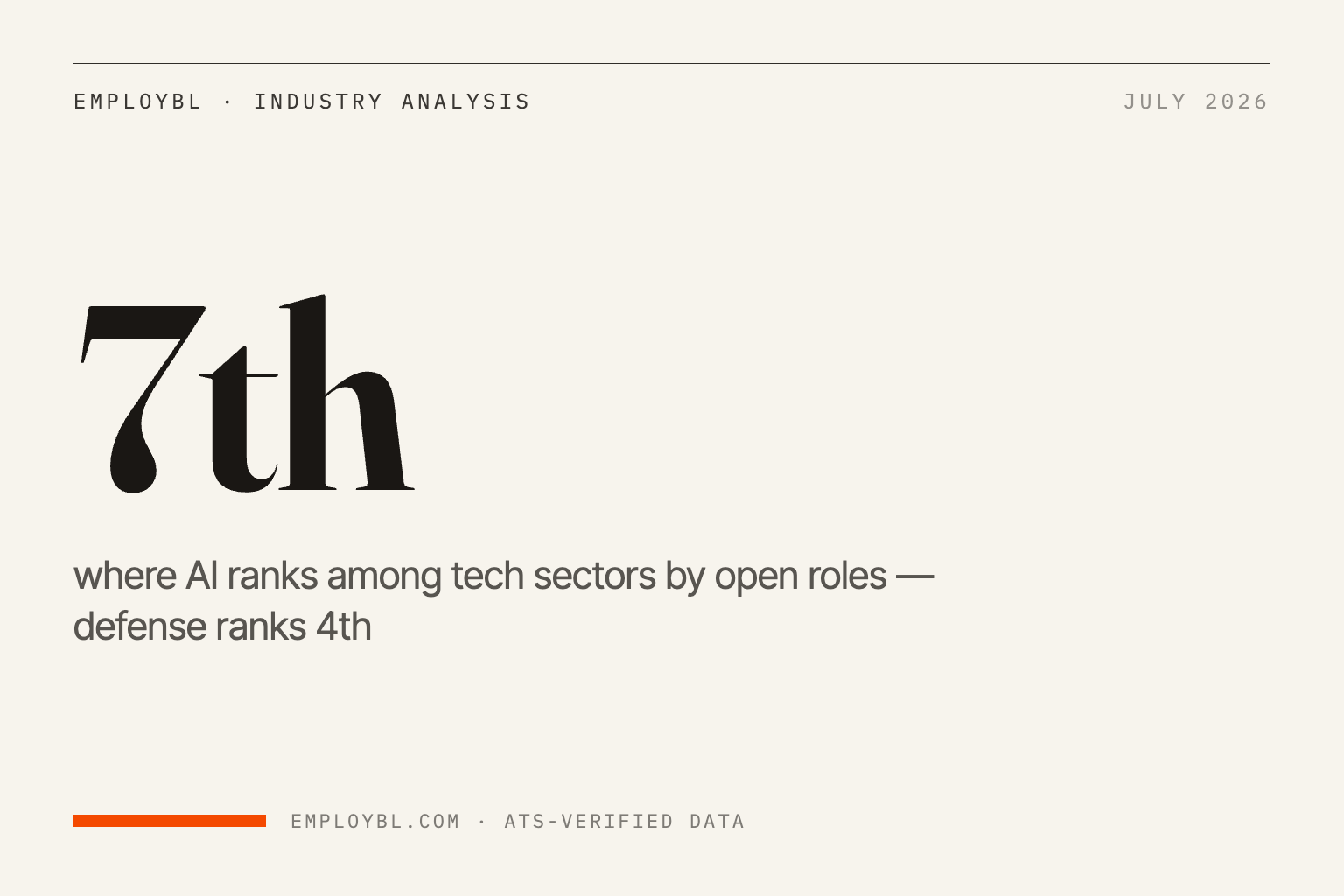
If you sized tech sectors by press coverage, AI would rank first by a mile. Sized by open roles, it ranks seventh. I run Employbl, and of the 90,150 active ATS-verified listings we track across 25,000+ companies, AI & ML companies account for 4,588 — behind developer tools, fintech, healthcare, aerospace & defense, consumer, and commerce. The sector that actually out-hires its narrative is defense: 398 companies posting 7,230 open roles, an average of 18.2 per company. AI companies average 2.6.
Scope, before the table: this is the Greenhouse/Lever/Ashby universe — venture-backed startups and scaleups. The defense primes (Lockheed Martin, RTX) run their own hiring systems and aren't here, so "defense ranks 4th" describes the venture-backed defense-tech world — the Andurils, not the primes. Big Tech's internal boards are likewise absent, and listings measure hiring intent, not headcount.
The sector table nobody's narrative predicts
Here is the full table — active listings, companies, and open roles per company — by each company's primary sector in our index:
- Developer Tools & Infrastructure — 14,186 listings / 3,283 companies / 4.3 per company
- Fintech — 10,492 / 4,103 / 2.6
- Healthcare & Biotech — 9,164 / 3,950 / 2.3
- Aerospace & Defense — 7,230 / 398 / 18.2
- Consumer — 5,985 / 2,156 / 2.8
- Commerce & Marketplaces — 4,744 / 1,407 / 3.4
- AI & ML — 4,588 / 1,770 / 2.6
- Cybersecurity — 4,416 / 1,105 / 4.0
The volume column is surprising enough — developer-tools companies post three times the open roles of AI companies. But the per-company column is the one that should recalibrate your mental model: the average defense company in our index is running 18.2 open roles, seven times the AI-company average. Anduril alone has 2,153 open roles in our tracker. SpaceX has 1,944. Shield AI has 415. No AI-native company outside the biggest labs comes close to those numbers.
See full profiles for these companies
A free account gets AI research, tech stacks, hiring focus, and 75K+ ATS-verified job listings — no credit card, and email alerts are free. MCP and REST access are free and uncapped too.
Sign up free →One honest caveat before you build a worldview on that 18.2: listings-per-company is skewed by company-size mix. The defense sector in our index is 398 companies — fewer, larger organizations — while the AI cohort is 1,770 mostly small startups. This is not apples to apples. But that asymmetry is itself the finding: the typical defense company in our index is hiring at a scale the typical AI startup simply is not.
1,770 AI companies, 2.6 roles each
The AI sector's problem is not company formation. With 1,770 AI & ML companies in our index, the sector has nearly as many companies as consumer (2,156) and more than commerce (1,407). The problem is that the median AI startup is small and hiring cautiously: 2.6 open roles per company, tied with fintech at the bottom of the big sectors. The AI boom, measured as a hiring event rather than a funding event, is a handful of large labs plus a very long tail of five-person teams. If your job-search strategy is "apply to AI companies because AI is booming," you are aiming at the sector with the seventh-largest surface area and one of the thinnest per-company pipelines.
Set the defense outlier aside and the comparison is still unflattering. Cybersecurity — a sector nobody is calling a boom — posts 4.0 open roles per company. Developer tools posts 4.3. Even consumer companies, the least fashionable corner of tech, post 2.8. On per-company hiring, AI & ML sits tied with fintech at 2.6, ahead of only healthcare's 2.3. Whatever the funding announcements imply, the average AI company is one of the thinnest hirers in the entire index.
Two readings of the gap
Why does venture-backed defense hire seven times harder per company? My best guess: these are capital-intensive manufacturing scale-ups riding a procurement supercycle. When a defense-tech company wins a program, it has to staff production lines, test infrastructure, and compliance functions simultaneously — and that shows up as dozens of concurrent recs in a way software scaling never does.
And why is AI's count so low? One reading is tiny-team leverage: the sector's defining trait is enormous valuations carried by small orgs, so sparse hiring is the business model working, not failing. A second reading is measurement: AI labs hire heavily through networks and referrals, and hiring that never touches an ATS never enters our index. That is a real undercount risk for this sector specifically — treat AI's 4,588 as a floor, not a census.
Where AI hiring actually is distinctive
There is one place AI-company hiring genuinely stands out, and it is not research: it is deployment. AI & ML companies are running 155 Forward Deployed Engineer listings across 47 companies — roughly one in every 30 AI-sector openings is an FDE rec, double the concentration at developer-tools companies (239 FDE listings against 14,186 total). We wrote up the full FDE explosion here — the short version is that the AI sector's most distinctive hiring motion is staffing engineers to embed with customers, not to train models. That tells you what these companies are actually building toward: production deployments, not papers.
Where should a job hunter aim, then?
If you are optimizing for open head-count, the boring truth is that developer tools, fintech, and healthcare together carry 33,842 of the 90,150 active listings — more than a third of the entire market. If you want defense-scale hiring, there are only 398 companies, but they are voracious, and most candidates never think to look. And if you want AI, walk in knowing the market you are actually entering: 1,770 companies, most hiring in the single digits. That is a market where a pointed, company-by-company search beats volume applying — when a company only has 2 or 3 openings, being the well-researched candidate matters far more than being the fastest one. Research the company — funding, team, hiring pattern — and check what they build with before you spend an evening on the application.
Methodology
Dataset: 90,150 active, ATS-verified job listings pulled directly from Greenhouse, Lever, and Ashby as of July 16, 2026, across the 25,000+ companies Employbl tracks. Each company is assigned one primary sector in our index and counted once; the table covers the eight largest sectors by listing volume. Listings-per-company is a mean, not a median, and is skewed by company-size mix — the defense cohort skews large, the AI cohort skews small — so read it as "hiring scale of the sector's typical employer," not as a like-for-like startup comparison. Individual company counts (Anduril, SpaceX, Shield AI) are current tracker totals pulled the same day. Coverage caveat: companies hiring through these ATS platforms skew venture-backed — defense primes and Big Tech run internal boards outside our index, and network-heavy hiring, common at AI labs, never enters it. Listings measure open recs, not hires made.